Tuesday, March 20, 2012

Ethos, Misogyny, and Redemptive Violence? in Peckinpah’s Straw Dogs


By Paul "The Good-Looking One" Goldberg

© 1.bp.blogspot.com 2011


I recently watched Sam Peckinpah’s 1971 film Straw Dogs.  Above all else, it stimulated my mind into thinking: what is the true point of this film—what does Peckinpah really want to tell us?  How does the film really deal with women?  What code of ethics guides David’s actions?  How was the film received at its release?

I’ll take the last one first.  It seems (in my brief glancing over Rotten Tomatoes) that the film was generally positively received upon release, but generated immense controversy and polarized its audience.  Some see it as a powerful statement of manhood, others view it as a compelling thesis undermining the morality and heroism of violence, while others think of it as dangerously misogynistic, and still others find it simply cliché and poorly conceived.  Thus, it’s safe to say that the film’s reception was divided; and indeed, it remains so to this day.

I loved it.  It’s probably one of the ten or fifteen most brilliant films I’ve ever seen.  Below, I’ll analyze several elements, ultimately seeking to clarify my perception of what makes this film to distinct and so distinctly brilliant.

Ethos

“Ethos” can be variously defined; but among its definitions is ‘one’s code’, as in, the code by which one lives.  And this is the sense in which I use the term in this essay.

In watching the film, the question arises: What is the code with which the film’s main character acts in accordance?

David Sumner (Dustin Hoffman) acts, throughout the first part of the film, by a code resembling thus: leave each to his/her own.  Such manifests itself in how he keeps to himself through much of the film.  He’s reluctant to socialize amongst the locals, he’s reluctant to confront his hired handymen when he knows they’re working far too slowly, he’s reluctant to confront them when he finds his cat hanged in his closet.  And conversely, he’s irritated at his wife’s (Amy Sumner, played by Susan George) every interruption of his astrophysical work, and he doesn’t hesitate to confront Reverend Hood (Collin Welland) when the reverend—in Sumner’s home—attacks Sumner for his field’s responsibility in developing the atomic bomb.  All this points to a kind of ‘live and let live’ attitude that Sumner seems to hold in his daily life.

But what drives Sumner in the film’s essential segment: the attempted break-in of his house?  One could say that indeed it’s this very same ethos that drives him to fight back, and eventually kill all his attackers: he only fights back—as in, when others violate his own personal space and freedom.  They aren’t letting him live his own life, and thus he fights to preserve his code’s fundamental tenet.  On this view, he chiefly fights out of a natural inclination to defend his personal space and freedom.  Such is supported by his frequent statements like ‘I won’t tolerate violence against this house’ And while such is indeed part of Sumner’s overall ethos in acting against his prospective intruders, does it compose the whole of it?

Another reason for his actions might be his wish to protect Niles (David Warner)—a man who, for all Sumner knows, is innocent, and in any case doesn’t deserve to be beaten to death.  As he states to Amy when she insists on giving Niles to the intruders in order to appease them and stop them from destroying her home, Sumner is aware of Niles’s certain death should the intruders get their hands on him.  And he can’t tolerate this inevitability.  So it might seem that he really values protecting innocent life.  But even this act may be seen through the lens of the above discussed code.  The central tenet of that code is that one’s man own freedom is what’s most important, and Sumner believes in (1) Niles’s right to life as an innocent man, and (2) his duty to protect that which is within his care, that which he freely chose to take into his territory.  And Niles is something that is within Sumner’s care of those things.  Thus it seems that, ultimately, the ‘live and let live’ code discussed above might be David’s only code.

Misogyny

One of the certain critiques levied at this film is that it’s misogynistic.  And for the most part, I can’t deny that.  There are really only two decently-large female roles in a cast dominated by males: the aforementioned Amy Sumner, and Janice Hedden (Sally Thomsett).  Neither is fully-dimensioned nor sympathetic.  Their being unsympathetic is especially jarring when considering that both deal with highly traumatic events in the film: Amy has an unavailable husband, deals with mental torment from the villagers working at her house, and is eventually raped by two of them; Janice either dies or passes out (the film is ambiguous) from being choked by Henry Niles.

While certainly neither of these women deserves what happens to them, they are nonetheless responsible for their actions, and their actions directly placed them into vulnerable circumstances.

Very few women would be so stupid as act like Amy or Janice.  And yet, the only two women in Peckinpah’s movie indeed act in just these ways.  Thus, in this instance, women certainly aren’t portrayed favorably in the film.  But furthermore, in the film’s most controversial sequence (the rape scene), Amy is portrayed as . . . well, enjoying it.  Or at least after initially resisting Charlie’s advances, she seems to give in and embrace him.  It’s indeed hard to not view this scene as a depraved reinforcement of the ‘rape myth’—the false belief that all women desire to be raped.  But although this scene is incredibly unsettling in that regard, I do think Peckinpah actually gives some empathy to Amy’s character in filming this and subsequent sequences, in which Amy has painful flashbacks to the rape.  I think that, in fact, Peckinpah shows the true brutality and violation of rape.

Instead of creating a stock scene in which the woman is steadfast in her feelings and hatred towards the man raping her, Peckinpah’s Amy has to deal with even further suffering: her confusion as to how she felt and still feels about what happened.  The fact that she had a previous relationship with Charlie, and remains physically attracted to him muddles her feelings about what happened.  Not only, then, does she deal with the humiliation of being violated, but she must also deal with confused and conflicting feelings towards the situation.  Rape is brutal because of the psychological damage more than the physical.  Peckinpah portrays that through Amy.

But as a last note here, it’s important for me to say that a man’s and a woman’s opinion about Straw Dogs likely vastly differs; indeed, in talking to a girl in my film class after we watched this movie, I was struck at how differently she perceived David, Amy, Charlie, and the film as a whole.  Considering how sparingly and unsympathetically it portrays women, it might be fair to say that this is truly a masculine film, and that female viewers may be left alienated from it.

Redemptive Violence

This last aspect I’m analyzing deals with the question of whether or not David’s violence at the film’s end should be seen as an act of cathartic redemption, regrettable animalism, or something in between.  My view is that it’s somewhere in between, although trending towards redemption.

But some (who think that his final acts should be seen as a sort of regrettable animalism) argue that David is the film’s villain—saying, essentially, that he subconsciously brings the violence of the villagers upon himself as an excuse for exorcising the repressed, violent demons within him.  There is a whole theory supporting this view, and one that should not be ignored.  But for space saving purposes, I’ll refrain from spelling it out.  I’ll simply express my objections to this position, which I believe are virtually insurmountable.  First, since David runs over Niles with his car, it subsequently becomes David’s moral duty to keep Niles safe until appropriate medical attention arrives.  And since David is unaware that Niles might have killed Janice Hedden, for all he knows, therefore, Niles is an innocent man.  David also knows that the villagers will surely beat Niles to death should they get their hands on him.  Therefore, he is faced with the proposition of either (a) letting a man whom for all he knows is innocent go to his certain death, or (b) risking some household violence in order to protect this presumably innocent man.  The moral thing, in most people’s minds* is certainly (b). 

When David hears the villagers shoot the magistrate (again, we have to get into David’s head: he doesn’t know that they only accidentally shoot the magistrate), he comes to the realization that they are now violent to the point of killing unselectively.

So again, we have to think: what are David’s options?  Either he should (a) send Niles—a presumably innocent man—to his certain death, or (b) do whatever is in his power to protect innocent life, even at the expense of the destruction of his house.  Once again, most moral theorists and everyday people would agree that the morally correct option is (b).  And thus, David does just that, and retains his claim to the moral highground.

And once the intruders actually break into the house, with the intent to kill, carrying deadly weapons, it is absolutely within David’s rights to mortally defend himself, his innocent wife, and his presumably innocent tenant.

Thus, I believe, sufficiently answers the question as to whether David is morally justified in his actions or not.  But another question remains: should they be seen as heroically redemptive, or tragically inevitable?  Well, the short answer is ‘both’.  They are redemptive in that, once and for all, David asserts himself and his manhood, and defeats the evil forces attempting to invade his life.  But Peckinpah’s brilliance here lies in his refusal to champion the villagers’ slayings as wholly praiseworthy.  The film ends in a void, depressed and tragic, where the violence and destruction lies bare; David has done what he had to do, but sometimes what we have to do still is tragic.  And when he leaves the house with Niles, it seems clear to me (and many other viewers) that his marriage with Amy is ruined beyond repair.

Thus, Peckinpah creates a story which’s brilliance hinges on the multi-dimensional views and emotions created by violence, misogyny, an ambiguous ethical code, and, ultimately, his ability to fully captivate his audience, bringing us with him along this terrifying, thrilling, and subtle ride.

*--In my initial post, I claimed that Kantian ethics would justify David's actions.  Upon further review, that claim is dubious: Kantian ethics might actually condemn David's actions.
______________________________________________________________

Monday, March 12, 2012

Post 84th Annual Academy Awards Recap (Video Review)

By: Alex "The Savant" Heisman and Paul "The Good-Looking One" Goldberg


We prepared a video for this discussion as our thoughts are more stream-of-consciousness as opposed to the rigid, quick structure of our past videos. The Two Half Jews truly come out in this slightly longer clip as we decided to act more as the best friends we are instead of our previous official personalities. Thanks, Paul, for not actually watching the ceremony and leaving me to carry this whole thing by myself :) Put on your beret, grab a baguette, and settle in!

-The Savant

_______________________________________________________________________

Thursday, February 23, 2012

84th Annual Academy Award Final Winner Predictions


By: Alex "The Savant" Heisman


Final predictions are always such a tricky thing. One’s mind churns rapidly before settling on a semi-coherent ultimate list of selections that you just can’t help but second-guess. Even then, a contender you wrote off before appears to be gaining steam in other’s minds. To be able to discern one’s own thoughts from the groupthink is the mark of a true Oscar prognosticator. There is also a level of pressure on my end as this is the first public instance of my give and take with Oscar.  I will probably, nay, definitely change my mind about something in the day or two between the posting of this article and the actual ceremony, although, once posted, that probably will not be reflected here. It must be stressed that these are the rankings of the strength of the contenders, not my personal preference. I apologize if this article becomes quite long, but that is par for the course. (All predictions listed in descending order of chance of winning- crappy design to list them, but it saves a LOT of space).

Best Picture

The Artist, The Help, Hugo, The Descendants, Midnight in Paris, The Tree of Life, Moneyball, Extremely Loud & Incredibly Close, War Horse

How long has it been since the film that truly deserves to win is actually going to? It sure seems like a long time, although, The Artist is going to right that wrong this year. No other film has garnered enough momentum to stop that train as nearest competitors The Help, Hugo, and The Descendants will just have to settle for their big wins in acting, techs, and writing, respectively. In the good old days, Midnight in Paris would be the fifth spot, the also-ran. The Tree of Life, gaining massive steam as of late, has started to rise way too late. While many bloggers cite Moneyball as their favorite movie of the year, it just doesn’t seem like anyone would actually vote for it. Extremely Loud and War Horse are non-starters.

Best Director

Michel Hazanavicius- The Artist, Martin Scorsese- Hugo, Terrence Malick- The Tree of Life, Alexander Payne- The Descendants, Woody Allen- Midnight in Paris

In a field of four masters and one newcomer, look for the previously unknown Frenchman to take it and match up with the expected Best Picture win. Scorsese, once a very close threat, has fallen recently. Malick, our favorite recluse, has turned in the most “original” directing accomplishment of the year but half are calling the film genius while the other half cries foul and declares pretension. Such a divisive split will be hard to overcome. Payne and his movie peaked way too fast, way too early. Allen’s nomination is a “welcome back!” to the category from which he has been absent since 1994.

Best Actor

Jean Dujardin- The Artist, George Clooney, Gary Oldman- Tinker Tailor Soldier Spy, Brad Pitt- Moneyball, Demian Bichir- A Better Life

I just don’t get how many are still finding this hard to call. Dujardin stars in the Best Picture frontrunner, charms the pants off everyone, and signaled a massive shift his way when he picked up the SAG award last weekend. Clooney, who was once destined to add a Lead Acting trophy to his Supporting one, must settle for second. Some, who am I kidding- ALL, would call me crazy for putting Oldman before Pitt, yet, the overdue Oldman, with his first nomination, actually turns in a damn fine performance while Pitt ------------------------ (censored, because I really just abhor Moneyball and how awful Pitt and Hill are in it). I personally found Bichir’s performance a smidge too calculated and self-conscious, but hopefully this nomination will allow the man many more choice roles in Hollywood films.

Best Actress

Viola Davis- The Help, Meryl Streep- The Iron Lady, Glenn Close- Albert Nobbs, Michelle Williams- My Week with Marilyn, Rooney Mara- The Girl with the Dragon Tattoo

My logical head says Davis while my emotional heart says Streep. If the Academy had just given Davis the Oscar for her stellar performance in Doubt instead of that tacky Penelope Cruz performance, we wouldn’t be having this problem now. Close and her film are dead in the water, yet it is so hard to believe that she has never won that she becomes the surprise snake in the grass contender if Streep and Davis split right down the middle (See- Best Actor 2002 when Adrien Brody pulled a huge upset and snuck right past dueling frontrunners Nicholson and Day-Lewis). Williams, once a fearsome threat, peaked with her Golden Globe win as “The Punisher” Harvey Weinstein threw all his chips behind his other, stronger contender in Meryl. Hey, Rooney! You snuck past Tilda for that fifth slot. Good for you! If you didn’t come across so arrogant and uncomfortable in interviews, maybe more people would respond to your performance.

Best Supporting Actor

Christopher Plummer- Beginners, Max von Sydow- Extremely Loud & Incredibly Close, Kenneth Branagh- My Week with Marilyn, Nick Nolte- Warrior, Jonah Hill- Moneyball

Plummer’s had this in the bag since his film premiered in June, as Captain Von Trapp earns his second nomination after a six-decade career. In a silent performance that’s not, repeat not, featured in The Artist, von Sydow also earns only his second career nomination. If his poignant character was in a few more scenes he might actually have a chance of upsetting here. Branagh has been comfortably settled in this category for a while but he hasn’t actually won anything. In a weaker year, surprise nominee Nolte could actually have won here, while I’m required to mention Hill, my favorite “comedian” working today, because the Academy nominated him for something.

Best Supporting Actress

Octavia Spencer- The Help, Berenice Bejo, Jessica Chastain- The Help, Melissa McCarthy- Bridesmaids, Janet McTeer- Albert Nobbs

Spencer wins here for lack of a strong enough rival. Bejo cements a high standing on the coattails of the strength of her film. Chastain, who exploded into the film community with six films this year (including fellow Best Picture nominee The Tree of Life), is now well respected enough, but won’t be able to eventually overcome her co-stars’ appeal. McCarthy’s nomination is a mixed bag. Half venture that she’s the next coming of the Lord and place her in second, while the other half, myself included, feel the performance gimmicky and the nomination reward enough. Janet McTeer fought very hard for that last spot so it’s nice to see her here, yet this second nomination for her will have to suffice at just that level.

Best Original Screenplay

Woody Allen- Midnight in Paris, Michel Hazanavicius- The Artist, Ashgar Farhadi- A Separation, Annie Mumolo & Kristen Wiig- Bridesmaids, J.C. Chandor- Margin Call

Another tough call. The best place to reward Allen’s movie would be here. He won the Globe in a semi-surprise and this film is truly his return to form. On the other hand, The Artist is gaining so much steam, it’s hard not to predict that it would take Screenplay too. Farhadi will win over in Foreign Language Feature so the nomination here is just a reassurance of how strong the film is in that other category.  There are many flaws with the screenplay of Bridesmaids (I won’t act bitter as I have already done so with Moneyball) so the nomination must suffice. Lastly, I’m very happy to see Chandor’s timely script make the final five, but it’s ultimately too small of a film to win.

Best Adapted Screenplay

Alexander Payne, Nat Faxon, and Jim Rash- The Descendants, Steven Zaillian, Aaron Sorkin, and Stan Chervin- Moneyball, Bridget O’Connor & Peter Straughan- Tinker Tailor Soldier Spy, John Logan- Hugo, George Clooney, Grant Heslov, and Beau Willimon- The Ides of March

As we are expecting Clooney to lose Best Actor, Screenplay becomes the best, and probably only, place to reward the film in which he stars. Payne is a respected storyteller with a win already under his belt for Sideways. The next closest contender, Moneyball, is something you know I don’t like so no use commenting on it. Tinker Tailor is the wordiest and densest of all the choices, and might win due to the sheer task of whittling down the original source novel. It's unfortunate, and vulgar, to say, but widower, Straughan, lost his wife, O'Connor, to cancer before the movie was released so perhaps a sympathy vote may pull of a win. The script is not the first thing one thinks of when it comes to Hugo, as the visuals overpower it and the pacing of the film needed to be tightened. Clooney and Co. just can’t win as their film only has this one nomination.

The Rest of the Field

Animated Feature- Rango
Documentary Feature- Tricky! Erm, Paradise Lost 3: Purgatory? Not my specialty, anyway
Foreign Language Film- A Separation
Cinematography- Anything but The Tree of Life would be a scandal
Film Editing- If Hazanavicius loses Director and Screenplay, he still wins of his three nominations here
Costume Design- Really wide open category, any could take it. I select Jane Eyre, as period pieces are favored here...although, The Artist may take it in a sweep
Art/Set Direction- Hugo’s rich visuals should support a win here
Makeup- Please, please, I beg you, give Meryl’s personal makeup designer his first Oscar for the outstanding aging work in The Iron Lady
Visual Effects- Rise of the Planet of the Apes
Original Score- The Artist relies so heavily on this I can’t see it losing
Original Song- Man or Muppet, The Muppets
Sound Editing/Mixing- Some combination of Hugo and War Horse? Massively difficult and odd categories that few predict correctly.
Live Action/Animated/Documentary Shorts- Notoriously hard to predict, most experts still get them wrong anyway. I abstain.

Sound off with your own predictions or thoughts below, friend us on Facebook, and tell us how you think we are doing. I'd just quickly like to thank my buddy and co-founder of this site Paul Goldberg, my parents for taking me to all the R-rated movies when I was too young, and those fellow pundits of mine (most notably- Sasha Stone, Jeff Wells, Kris Tapley, Brad Brevet, Nathaniel Rogers, Scott Feinberg, Tom O'Neil, and Chris Beachum) that have analyzed and obsessed over these awards with me for the past six months. Through ups and downs, it's truly been one hell of a season. See you all after the fracas this Sunday night!
_______________________________________________________________________

Friday, February 17, 2012

(Glenn) Close but No Cigar: When Stagnation Turns Ugly


By Alex "The Savant" Heisman

I figured it best that I at least chime in one more time on the Oscar race before my final prediction piece for the ceremony on February 26th. It seems unbelievable to me that a time usually so vibrant with life and ruthless campaigns can be so anticlimactic and droll as this year is playing out to be. It’s actually rather unfair more to our readership than myself as, instead of a month where I personally feel my writing can really take off in covering the race, I am forced to write monotonous pieces with a somber undertone of slightly morbid finality. I promise, readers, that The Savant will truly emerge and become as ruthless as some of the studio campaigns during next year’s Oscar coverage when I take sides, argue my points, and regain the understanding and love for the sport that has begun to falter this year.

I have no particular theme for this article, as, indeed, I am basically forcing myself to write it. There are a few things, however, that I wanted to touch upon so that one may be aware of them in leading up to the ceremony:


The Battle for Best Actress Heats Up
The only real tension this season does, in fact, lie in the one place destined to give me a heart attack. Close friends Meryl Streep (The Iron Lady) and Viola Davis (The Help) are essentially tied 51/49- favoring Davis- for the win in the Best Actress category.  When Meryl Streep won the Screen Actors Guild award in 2008 for her role in Doubt, she begged the moviemakers in the room to please “give (co-star) Viola Davis a leading role soon!” Little did she know that “soon” meant just three years later in a role that would provide for her stiffest competition towards the Oscar. Both women are massively talented- and I promise I will actually compose the “Why I Love Meryl So Much” piece after the Oscars. If Paul can write his magnum opus on Crash, it’s time for mine- so a win for either would certainly not be a negative thing. The Help is better received than The Iron Lady, although The Help did miss extremely crucial Directing, Writing, and Editing nominations that can hurt Davis. The precursors also give us no discernable frontrunner as Streep hauled the Golden Globe and BAFTA awards whereas Davis took the SAG and Broadcast Film Critics Choice awards. Many factors including her age in a industry that values young ingénues, her previous two wins, and not being an African-American woman seem to signal that Streep must AGAIN sit this one out while voters progressively tick off the box next to Davis’ name. Either way, I will be anxiously awaiting this particular category all night!


Can Sound Mixer Greg P. Russell Finally Pull Off a Win?
An affable looking man, going off of his IMBD photos, Russell earns his fifteenth
nomination this year for his work in mixing aural elements for the flick Transformers: Dark of the Moon. Even though they aren’t household names, Russell and his friend and co-sound mixer Kevin O’Connell are actually pretty famous within the Academy…. for a disturbing reason. O’Connell has twenty Oscar nominations, with Russell now earning his fifteenth, without a win between them. They are the two most nominated individuals in the history of the Academy Awards without a win. While O’Connell is not nominated this year, Russell must face off competition from the mixing teams from The Girl with the Dragon Tattoo, Hugo, Moneyball, and War Horse. Shall we expect to see Greg P. Russell finally anoint the stage with his presence and thus be anointed by the golden man in the process? Smart money says unfortunately not. Hugo, with regards to the sounds emanating from the locomotives, and War Horse, for all the do-to about the war elements, stand a better chance here than the third entry in a stale, poorly received summer blockbuster franchise.


Terry George is Nominated WHERE?!
Famous Irish filmmaker Terry George earns his third career nomination with a placement in the Live Action Short category. With two previous failed nominations for writing In the Name of the Father and Hotel Rwanda, George, along with his daughter Oorlagh (there’s a name!), are in the running for their 29 minute film The Shore starring Ciaran Hinds, Conleth Hill, and Kerry Condon. Usually both being a named filmmaker and using big-name actors is enough in this category- famous directors and actors Walt Disney, Taylor Hackford, Christine Lahti, Peter Capaldi, Susan Seidelman, Kenneth Branagh, Ray McKinnon, JoBeth Williams, Jeff Goldblum, Andrea Arnold, David Frankel, and Martin McDonagh have all won or been nominated for Oscars in this category- is enough. In a simple maneuver, if voters tick off the right box in this instance, the world can add one more name to this stellar list and say Academy Award Winner Terry George. Most pundits agree that George will probably not win in this category, although shorts are somewhat harder to predict. I personally will be rooting for him and his daughter.


Will Woody and Terrence Actually Show Up?
No they will not. The skittish Woody Allen has never attended the Academy Awards, save once, a couple months after 9/11, when he told a few jokes and gave a speech pleading filmmakers to come back and make films in his beloved city before he introduced a package of film clips put together by Nora Ephron, quickly left the stage, and exited the auditorium altogether. This appearance, known only beforehand by host Whoopi Goldberg and the producers was one of the craziest things to ever happen at the Oscars. Allen has been quoted as saying immediately after he won two awards for Annie Hall, “I have no regard for that kind of ceremony. I just don’t think they know what they’re doing. When you see who wins those things- or who doesn’t win them- you can see how meaningless this Oscar thing is.” Allen has never collected any of the three Oscars he has been awarded over his career, instead electing to play his clarinet at his favorite jazz club into the wee hours of the morning.

Likewise, publicity shy and super-recluse Terrence Malick will also not be there. Malick has only made five films over the course of his thirty-nine year career, as he prefers to write hundreds of pages, and shoot and edit over a million feet of film in a massive and time-consuming process. Only one photograph of him is known to exist, as Mr. Malick is probably the shyest person in the world. He has it written into his contracts that no interview can be taken with him, no photo of his can be used in promoting the film, and that no one may speak on his behalf or about him. Often misunderstood as arrogance or indifference, Malick caused quite a stir when it was rumored that he was in the building when his film The Tree of Life won some big awards at this year’s Cannes Film Festival. While Malick did not, in fact, grace the stage, he was waiting backstage nonetheless. Rumor has it that he is actually somewhat thrilled at his nomination this year and maybe, perhaps, could be, pondering, weighing the pros and cons, thinking about attending. He might even be able to pull of a surprise win in Best Director, however, the only other time he was nominated (twice in the same year), and did not attend, he did not win. This may signal that the Academy wants to honor someone who will actually show up and act grateful for the honor of winning. Of course, Malick may not actually exist after all and could be a conspiracy orchestrated by the powers-that-be!

*It must be noted, however, that Malick’s longtime producers broke the cardinal rule last time around in promoting The Thin Red Line and spoke on his behalf in an interview about the Oscars. Malick was reportedly so incensed that he flat-out refused to attend and wanted invitations rescinded for the two men who were in error. Malick finally relented when the Academy agreed to place the men and their wives in the middle of a row at the very back of the theater. The information regarding his possible attendance this year comes from, you guessed it, these two men. So, take that with as large a grain of salt as you want. Either way, Malick ACTUALLY showing up would be tantamount to a Bigfoot sighting, if not even more elusive and radical.


Godspeed fellow Oscar watchers as we plunge into the abyss that is less than two weeks before the ceremony. By the time this article is posted my birthday will have passed (so I wanted to plug my own birthday- sue me) and there will be even less days till the shindig. See you around for my final prediction review!
______________________________________________________________________
Saturday, February 11, 2012

Transcending Racism in Crash: Why It's Right and You're Wrong


By Paul "The Good-Looking One" Goldberg


© onublsa.files.wordpress.com 2011
With the Oscars approaching now ever faster, you’re sure to come across a couple of articles entitled something like the following: “10 Worst Oscar Winners of All Time”.  And almost for sure, one of the movies that will make the list for worst Best Picture winner ever is Paul Haggis’s 2005 Crash—critics bashing it resoundingly.  So of course, the question arises: why does this so frequently make these lists—what’s wrong with it?  Well, critics tend to offer several reasons:
• Ang Lee’s Brokeback Mountain should have won
• Crash’s plot is based off of unrealistic coincidences
• Crash is too straightforward and overbearing in arguing its thesis
• Crash panders to the liberal, PC Hollywood mainstream,  infested with white guilt
• Crash depicts its various characters as one-dimensional, racial stereotypes
• Crash’s views on race relations are facile and old-fashioned


What I’m here to say is this:  all of the above critiques are either wrong or insufficient reasons for faulting the film.  It’s my contention, which I will herein argue, that Crash not only rises above such critique, but moreover rises above most any film ever made (or at least, that I’ve ever seen) in the dimension of its characters, the depth with which it considers race relations, and its transcendent painting of human goodness.  Within this article, I’ll (a) argue against every above stated critical objection, and (b) offer a general view of why Crash should be considered as among the greatest films ever made.


1. “Ang Lee’s Brokeback Mountain should have won”
I’ve never seen Brokeback Mountain, and thus I’m in no position to comment on its vs. Crash’s worthiness of winning the 2005 Best Picture Oscar (although, from what I’ve heard of Brokeback Mountain, it seems that it is the film that panders to Hollywood’s liberal political correctness—not amounting to much other than its groundbreakingly mainstream portrayal of homosexuality).  Nevertheless, whether or not there was a more worthy nominee, just because you don’t agree with Crash’s victory is hardly a reason to dislike the film.  That would be like saying that because Hamlet is considered Shakespeare’s best play, while you believe Othello is superior, therefore Hamlet is a bad play.  That logic doesn’t follow.


2. “Crash’s plot is based off of unrealistic coincidences”
Yes.  This is true.  Crash’s plot is based off of totally coincidental events.  However, this in itself is hardly a reason to dislike a film.  Many of Alfred Hitchcock’s films involve a highly unlikely plot structure, and we don’t say that they are thus bad films.  Rather, we accept Hitchcock’s implausible plot structures on the basis that they contribute to a larger metaphor that his films attempt to illustrate.  Ditto for Crash—although the film’s events are highly unlikely, they are as such on purpose: to illustrate the inter-connected nature of human thought and action; to represent as a metaphor the way in which our every thought and action affects our larger human community, and either contributes positively or negatively to our environment.


3. “Crash is too straightforward and overbearing in arguing its thesis”
This critique strikes straight to the heart of the pretentiousness and intellectual shallowness of mainstream critics: they think that just because a film clearly communicates its thesis, it therefore must be facile and overbearing.  Folks: straightforwardness and clarity is a VIRTUE; it’s characteristic of unfocused and intellectually shallow directors to hide behind obscurity, ambiguity, and unnecessary intricacy (**cough cough CHARLIE KAUFMAN cough cough**), just as it's characteristic of intellectually shallow politicians to hide behind big words and non-committal slogans.  What’s much more difficult, as we should know, is to explore complex themes in a subtle, yet straightforward manner.  That’s exactly what Crash does: the manner in which all the characters coincide and come to a personal catharsis is subtle, intricate, and thematically linked.  And yet: the overall point of the film is quite clear, and indeed its thesis is clearly argued.  Haggis ingeniously pulls off such a difficult synthesis.


4. “Crash panders to the liberal, PC Hollywood mainstream,  infested with white guilt”
Crash hardly should be said to pander to the liberal, PC, white-guilt-infested Hollywood.  Why?  Because it lays blame on not only whites for the degradation and inflicted terrors of racism, but instead on every individual—no matter what color.  In the film, racism is displayed as a two-way street, with the individual ultimately responsible for transcending its limiting bounds.  Each character—with the notable exception of Michael Pena’s Daniel—(I) receives unjust treatment due to some damaging racial stereotype, but (II) also acts in accordance with this stereotype, contributing to its acceptance and influence.  For instance, in the scene at the beginning of the film, in which Anthony (Chris Bridges aka Ludacris) complains to Peter (Larenz Tate) about the hatred and alienation they feel from the stares of those around them, as two young black men in a rich, predominantly white neighborhood, Haggis perfectly illustrates this self-perpetuating racist mechanism:  immediately after complaining, Anthony and Peter carjack a rich white couple’s Lincoln Navigator.


Similarly, Officer John Ryan (Matt Dillon)—a white cop—feels betrayed by the system of affirmative action that put his father—a white small-business owner who hired blacks before it was socially accepted or legislatively sanctioned—out of business.  But instead of taking this righteous indignation out on the system that caused this injustice and fighting for positive change, Ryan unjustly takes his frustration out on blacks themselves, thus contributing to the white-supremacist, racist power structure that made affirmative action a necessity in the first place.


Thus, it should be clear that Crash doesn’t pander to the Hollywood PC, white guilt sensibility.  In his advocating of individual responsibility for the abolition of racist preconceptions, and pointing out of the ills of affirmative action, Haggis raises issues within his film that are a far cry from both political correctness and white guilt mongering.


5. “Crash depicts its various characters as one-dimensional, racial stereotypes”
The fault in this criticism I have partially addressed in section (4).  However, diving in further, it should be clear that the characters in Crash are multi-dimensional human beings who transcend any racial stereotype.


First, as already discussed above, most every character functions as a complex interaction of socially-inflicted racial stereotypes and self-perpetuation of such stereotypes.  Different from Spike Lee, who seems to suggest in his 1989 Do the Right Thing that all racism (in America) is solely due to an oppressive white-dominated society, a society in which all whites and no blacks/minorities are to blame for the existence of such racism, Haggis in his 2005 Crash forces the brunt of the responsibility back on each individual:  essentially, he’s saying ‘YOU be the change; if there’s an untrue and damaging stereotype affecting you, refuse to take part in action that only furthers the stereotype and thus contributes to your oppression’.  Thus, in holding all individuals at least partially responsible for abolishing the stereotypes that limit them, Haggis upholds the power and multiplicity of his characters and what they represent.


6. “Crash’s views on race relations are facile and old-fashioned”
I’ve seen it claimed that Crash’s thesis on race relations—individuals thinking and acting in accordance with stereotypes is the central root of racial issues—is old-fashioned, compared to the more postmodern, Marxian view of racism as stemming from and ultimately perpetuated by a white power structure.


I’ll concede that Crash certainly doesn’t settle for the simplistic view of modern American racism as solely perpetuated by a white power structure.  However, in my eyes, this is a positive of the film, something lending credence to Crash’s claims to nuance in its treatment of racial issues.


Haggis seems to support the idea that it’s in-group/out-group thinking, the false and arbitrary racial distinctions that exist, which lead individuals to form false, damaging stereotypes that they then conform their thought and action towards—he seems to claim this as the root of racial problems in modern America.  To me, such is a far more nuanced and less facile view of race relations than the more predominant Marxian theory expressed above.


© http://img2-1.timeinc.net


Crash’s Transcendent Argument for Humanity


Thus Far, I have refuted the most common and consistent attacks against Crash, contending that they all are illegitimate critiques.  But in the remaining space of this essay, I’ll go one step further and give a positive argument for the integrity of the film’s structure, and the power of its transcendent view of humanity.


Crash’s central plot pattern is as follows: (A) individual is beset by racist stereotype, (B) individual lashes out at another racial group in a small way, (C) individual is confronted with a life or death situation in large part caused by step (B), in which the racist stereotype is either transcended and thus resolved, or brought fatally to bear.  The only variation is that sometimes (A) and (B) can be chronologically switched.


This plot structure can be illustrated through Farhad (Shaun Toub), the Iranian store owner: (A) Farhad comes to his shop one night to see that it’s been robbed and vandalized with anti-Islamic phrases spray painted throughout, (B) Farhad blames Daniel (Michael Pena), the tattooed, Hispanic locksmith whom he earlier hired to fix his door but eventually fired out of distrust, and finally (C) Farhad takes his gun to shoot Daniel out of revenge and despair.


Another example of this very structure is present in the interaction between Officer Ryan and Christine Thayer (Thandie Newton).  From Officer Ryan’s Perspective: (A) Officer Ryan’s father’s history with affirmative action has hardened Officer Ryan into a racist, (B) Officer Ryan pulls over a guiltless black couple on trumped-up suspicions and sexually assaults the woman (Christine) in what he calls a ‘pat-down’, and (C) Officer Ryan is called to the scene of an accident to help a trapped woman escape from her car, which is about to be consumed by fire; the trapped woman turns out to be Christine, and now in addition to the struggle of getting a trapped woman out of her soon-to-explode car, he must confront her fears of him and his own racism.


Examples of this structure abound; essentially, in using such a consistent structure, the film has a looping effect, allowing the audience to see the inter-connectedness of human interaction, and the powerful, macro effects of racist thought and action initially performed on a micro level.


This structure also illustrates the possibility humans have of transcending our racist preconceptions and coming to an understanding of the universality of humanity—no matter the skin color.  As stated, step (C) of this structure confronts those involved with a choice: either realize the pettiness and foolhardiness of your racism, and thus resolve the situation and conserve life, or stay consumed in your prejudice, and continue on the course to death and destruction.  In the film, both options are pursued, and at times life is conserved and the racial situation resolved, and at times the racial situation is brought to bear, resulting in death or intended death.


The fact that both options might be pursued proves that Haggis believes it is in the individual’s ability to transcend racial prejudice and connect with others on the more fundamental level of humanity.


Overall, Crash should be seen to grapple with various deeply weighty topics—successfully.  It upholds the power of the individual to either descend to or transcend racial thinking and action, while also illustrating humans’ profound, inter-connected and interdependent nature in the effect that any individual’s thought and action has on many others.  It deals with the reality of human beings as complex social creatures, creatures whose views and prejudices are influenced by various sources.  Thus, Crash paints an ultimately empathetic view of humanity and each individual composing it—a rarity in the finger-pointing racial films prevalent today.  Its enduring legacy will be shaped by the unusual depth with which it tackles the issue of race relations, and the transcendent hope it has in each of us as individuals to forge humanity’s path in accordance with our true nature: that distinctions based upon skin color are arbitrary and worthless; what matters is rather what we share: a fundamental human soul.
______________________________________________________________________


Thursday, January 26, 2012

Academy Award Nomination Recap

By Alex "The Savant" Heisman


Well….in fact, I don’t want to say much more than just: …well. I have never been more disappointed with the overall annual list of Academy Award nominations as I was this year. I am fully aware, of course, that one must take the nominations with a grain of salt and that, more often than not, AMPAS is not a true bellwether of “best” and “greatness”, as they so readily purport to be.


This year’s nominations, however, finally made me acutely aware of the infamous “turnover moment” that all the Oscar prognosticators that came before me speak of. This moment, and this is not myth for they each detail the moment it happened to them, refers to the literal single second when Oscar bloggers learn to stop caring. These bloggers certainly still care about film, the state of cinema, and how their predictions reflect who eventually wins/loses, yet, perhaps due to a terrible roster of nominations, they just don’t personally give a damn as to who the nod goes to. (David Carr of "The Carpetbagger" even famously gave up covering the entire Oscar race forever, as he was so disillusioned with the 2008 roster). Through my nine years of Oscar watching and obsessing, I have invested myself deeply with the course of a few particular films or performances each year, becoming severely distraught when these selections don’t even come close to winning. How! Why! How Can This BE!?!, I ask myself rhetorically, never expecting nor receiving any answer. It is with an unfortunate voice, and a morbid tone, that I then compose this article. For you see, roughly around 8.42 am EST on Tuesday, January 24th, 2012, I stopped caring.

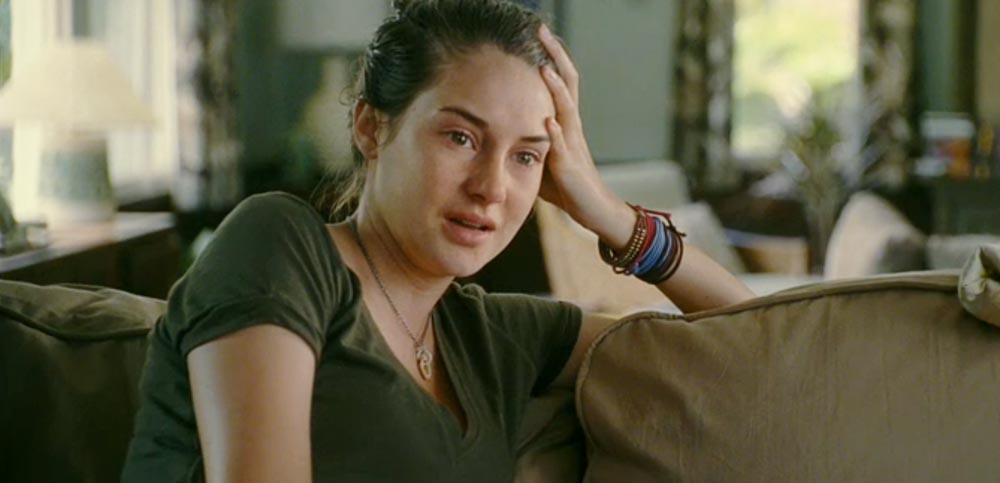
Shailene just doesn't understand it either.  ©filmofilia.com 2011 

I eagerly and anxiously awaited the start of the announcement ceremony at 8:38 am, yet when the four minutes were up that it took to recite who did and did not get nominated, I saw what a tremendously atrocious selection of final contenders we had. I then clearly and distinctly experienced my turnover moment. I now can only forever examine the Oscar race without emotion or personality. I even remained on board the ship when they gave Sandy Bollocks Best Actress two years ago. In the most unpredictable and fractured Academy Award race I’ve ever experienced, the most bland and tasteless selection of nominees has presented itself.

Instead of a traditional nomination recap where I look at a select group and analyze this or that, you can see I’m four paragraphs in and I haven’t even mentioned a single nominee. It’s not even worth it.

There were obviously a few nice shockers, however; I still can’t believe they went for Gary Oldman’s massively layered and complex performance in the brilliant Tinker Tailor Soldier Spy. Also, kudos to them for highlighting Max von Sydow’s heartbreaking acting in Extremely Loud & Incredibly Close.

Otherwise, RIP Michael Fassbender’s massively brave and literally naked performance as a sex addict in the harrowing Shame. RIP Albert Brooks, in a perfect career resurgence, as the most menacing and crazy gangster to ever grace the silver screen. RIP Shailene Woodley, who showed that extreme beauty and talent for someone not yet even legally able to drink doesn’t have to get in the way of one of the most heart-rendering and poignant scenes of the year: the pool scene. Come on Academy, really….you obviously saw The Descendants. You nominated it a whole bunch of times elsewhere. Did you even FREAKING see the pool scene?? It’s one of the only scenes everyone’s talking about this year! Well… (and there’s that
“well…” again) apparently not. Looking at this embarrassing list of exclusions, who’s even left that I could root for this year? Oh, yea, hi Meryl! (:

Oh, but excuse me! I’m not letting passion get in the way anymore.

I, of course, will follow the race closely over the remaining four weeks, but I won’t care a lick. That’ll make it that much easier to put a brave face on whenever I am reminded that I must now and forever refer to these people as “Academy Award Nominee Jonah Hill”, and “Academy Award Nominees Melissa McCarthy and Kristen Wiig”. 

__________________________________________________________________

Monday, January 23, 2012

Extremely Loud and Incredibly Close (Video Review)

By Alex "The Savant" Heisman and Paul "The Good-Looking One" Goldberg
The Savant's Rating: 3/5 Stars
The Good-Looking One's Rating: 4.5/5 Stars


My apologies for that shrieking noise increasing in the background during my analysis of the film.  I guess God didn't think I had much worth saying.  And once again, my apologies for the poor video quality on my end.  That's what happens when you get a crappy Dell, people. (The Good-Looking One)

Enjoy, folks. (The 2 Half Jews)

____________________________________________________________________